
KEY SUMMARY
mall B2B events such as dinners, happy hours and breakfasts, hosted near a conference your buyers already attend, do three jobs at once: they build your brand with prospects, speed up deals already in your pipeline, and turn customers into people who sell for you. Most teams judge events only on new leads, which is why so many struggle to prove ROI. Measure each job separately. In one six-month program run for a mid-market SaaS company, which fell in a strong buying window, six events costing $45,000 to $50,000 created about $276,000 of pipeline and about $70,000 in won deals. Treat that as a good result, not a benchmark.
Ask a senior buyer for a meeting and you'll wait weeks. Ask them to dinner the night before a conference they're already flying to, and they say "count me in" the same day.
One invite we sent, for a small dinner the night before a conference, got that exact reply from a Head of Infrastructure at a global bank the day it went out. There was no pitch anywhere in it.
Most companies still treat events as a way to find new leads. That's one job out of three, and usually not the one that pays.
Why nobody says no to an event
A meeting request asks for something: thirty minutes of a busy person's week, usually to hear a pitch. An event invite gives something: a good dinner, a room of peers, and a reason to be somewhere they were going anyway.
That difference changes the whole relationship. Once a buyer has said yes to your dinner, you're no longer a name in their inbox or a face in their feed. You're the people who hosted that evening.
Buyers still want this, even as more of the buying journey moves online. In McKinsey's 2024 B2B Pulse survey of nearly 4,000 decision-makers, 41% said they prefer meeting in person when they're dealing with a new supplier. A small room is the easiest way to give them that before there's any deal to discuss.
One room, three jobs
A good room has three kinds of people in it, and each one does something different for you.
Job 1: Brand, with people not yet in your pipeline. They meet you in person, and they meet the people around you. If someone spends an evening talking to three senior leaders at your table, they leave thinking you're a company worth working with, whether they buy this year or not.
Job 2: Acceleration, with deals already in your pipeline. Time kills deals. A prospect who's in town and spends two hours with you tells you more about where the deal really stands than six weeks of email. Seat them next to a customer, and let the customer do the talking.
Job 3: Champions, with your customers. Put them on the panel. Make a short video with them. Give them better swag than everyone else. They feel appreciated, and they do your marketing for you, in the room, to your prospects.
The real power is that the three groups convince each other. A prospect hears a customer talk about you without being asked to. A stalled deal sits next to someone who signed last quarter. That's the one thing a booth can never do.

Prospects, open deals and customers in one room. Each group does a different job for you.
There's a quieter effect that runs through all three: introductions. Customers who feel appreciated refer more, and some do it right there in the room by walking a prospect over to you.
It doesn't stop with customers. A prospect who isn't buying this year, or an open deal that ends up going elsewhere, will often make an introduction as a courtesy once they've spent an evening with you. If they know someone who is in a buying window, they're happy to connect you, because the trust is already there. No email sequence earns that.
What six events in six months produced
Here's what this looked like when I ran it. A US mid-market SaaS company was running no events at all, and we moved it to one a month. Over six months it spent $45,000 to $50,000 in total.
These are the deals that came from those rooms, counting only deals sourced from the events:
Prospect | Qualified | Demo | Won | Closed lost | Total | |
|---|---|---|---|---|---|---|
Deals | 1 | 4 | 1 | 5 | 4 | 15 |
Value | $22,500 | $75,540 | $18,750 | $69,750 | $90,000 | $276,540 |
That's about 5.5 to 6 times the spend in pipeline. The won deals alone are already about 1.5 times the spend, with $116,790 still open.
Read these as a good result, not a typical one. I ran these events myself, so the invite lists, seating and follow-ups were done the way this post describes. They also fell in a strong part of the year, when many of the company's buyers were in a buying window; another six months could easily look smaller. And the pipeline total includes $90,000 of deals that were later lost, so it's the pipeline the events created, not revenue.
In one way the case also undercounts. It includes only deals that started at an event. It leaves out the open deals that moved faster because the buyer sat next to a customer at dinner, and the introductions that came out of those rooms.

Six small events, about $50,000, and $276,540 of pipeline, in a strong buying window.
Most teams run events for the wrong job
Marketers already believe in events. In Bizzabo's 2025 State of Events report, 78% of event organizers called in-person events their most powerful way to engage their audience and meet marketing goals. Yet only 24% said pipeline growth was the top priority for their in-person B2B events.
The proof is just as thin. In industry surveys summarised by Event Marketer, 70% of marketers said they struggle to show ROI on in-person conferences, and 54% of US marketers aren't tracking registrations to measure impact at all.
I think both numbers come from the same mistake. Teams run events as one job, usually brand or lead capture, and then measure them on another. A booth produces badge scans, so the event gets judged on badge scans, and badge scans rarely turn into revenue.
The operators who measure pipeline tell a different story. When Wynter surveyed 100 marketing leaders at B2B SaaS companies with more than $50 million in revenue, 16% named in-person events their most reliable pipeline source, ahead of email sequences, paid ads and webinars. It's a small survey, but the direction matches what I've seen: the events that work are small and focused, and they're measured on deals, not scans.
A room you control beats a booth
You don't need a booth to win a conference. You need a room you control, close to where your buyers already are.
There are three ways to show up:
Attend. No booth. Book short meetings on the floor and go to the parties. Best for a first conference or a tight budget.
Host a side event. Your own dinner, happy hour or breakfast near the venue, for 20 to 60 people. This is the default.
Run a flagship. Your own half day of talks, then food and drinks, for 60 to 100 or more. Only once you've run a few side events and have partners to co-host.
The side event is where most of the value sits, because your buyers have already paid to fly in. A few rules decide whether it works:
Timing. The night before the conference, or the first two days. Never the last day; everyone has a flight.
Distance. Within a ten-minute walk of the venue. Nobody takes a cab to a vendor's happy hour.
Size. A first dinner should be small. 16 seats is a good number.
The guest list is the event. A beautiful venue with the wrong guests is an expensive dinner. A plain room with three senior buyers, two happy customers and one great panelist is pipeline.
One number to plan around: about half of the people who say yes actually show up. Plan the invite list backwards from the seats you want filled.
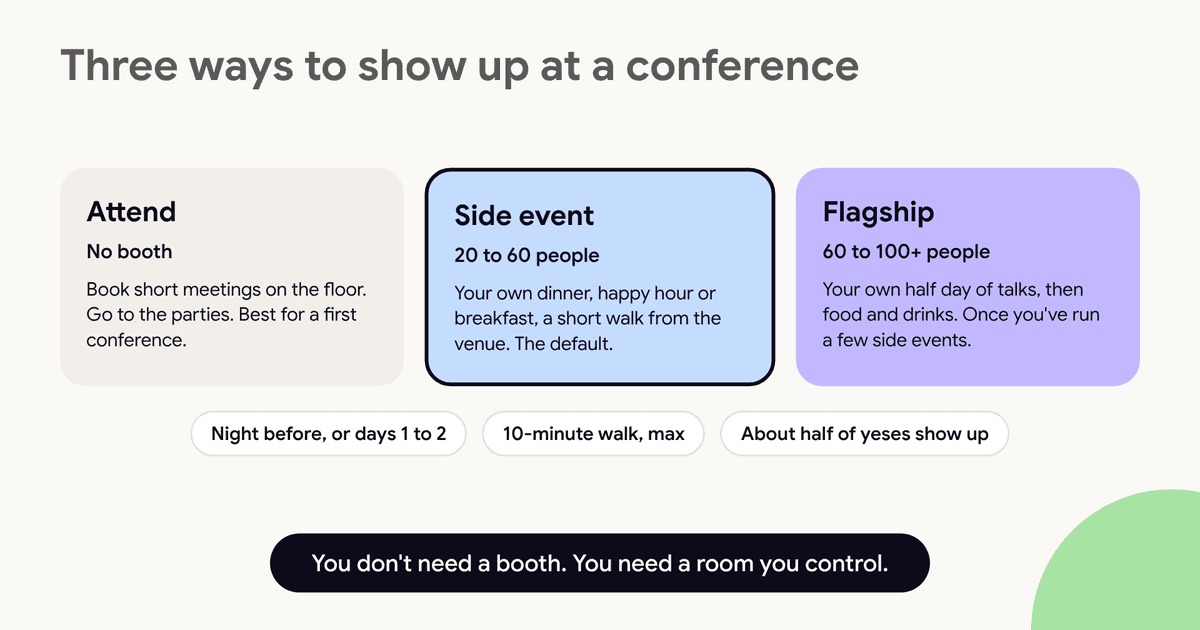
The side event is the default: your own room, a short walk from where your buyers already are.
Measure each job separately
If an event does three jobs, it needs three scores. Judge a dinner only on new leads and you'll cut the format that was quietly closing your biggest deals. A room can miss on new pipeline and still pay for itself because three open deals moved.
Here's what I count for each job:
Brand: how many new people from your target accounts you met in person, and how many replied to the follow-up.
Acceleration: how many open deals that attended moved to the next stage, and how much faster than deals that didn't come.
Champions and referrals: what your customers produced afterwards, such as a video, a quote or a post, and how many introductions followed, from customers and from prospects who didn't buy.
Efficiency: cost per attendee, the share of confirmed guests who showed up, and meetings booked per $1,000 spent.
Start measuring from your very first event. That first room is your baseline, and every event after it should beat it.

Judge an event only on new leads and you'll cut the format that was moving your biggest deals.
Where to start
Pick one conference your buyers already attend. Look at where your contacts actually live, too; your biggest cluster tells you which city matters. Then host one 16-seat dinner the night before it opens, within walking distance of the venue.
Fill it in three parts. Invite prospects personally, from the face of your company, not from marketing. Ask each sales rep to invite the open deals they own. Ask one or two customers to join the panel rather than just attend. Skip the banner and the swag table, keep the panel to 20 minutes, and don't open a laptop at the table.
Then follow up within 48 hours, with a different message for each group.
Most teams buy a booth and hope the right people walk past it. The teams that win pick the right people first and give them a reason to sit down together.
The full system, including invite templates for each group, the venue tracker, the run of show and the follow-ups, is in The B2B Events Playbook.
FAQs
Do B2B events actually generate pipeline?
They can, when they're small, targeted and measured on deals rather than badge scans. In one example that fell in a strong buying window, a mid-market SaaS company spent $45,000 to $50,000 on six events over six months and created about $276,000 of pipeline, with about $70,000 won. Results vary by season and execution. Events also speed up existing deals and lead to introductions, which pipeline reports often miss.
Is a side event better than a conference booth?
For most B2B companies selling to senior buyers, yes. A booth collects walk-up traffic. A dinner or breakfast near the venue lets you choose exactly who is in the room, seat prospects next to customers and have real conversations. Booths still help large brands that need visibility on the show floor.
What is the best day to host an event during a conference?
The night before the conference opens, or the first or second day. Avoid the last day, when most people are leaving. Keep the venue within about a ten-minute walk.
How many people should you invite to a B2B dinner?
Plan for about half of the people who say yes to show up. For a 16-seat dinner, aim for roughly 30 to 35 confirmations, which usually means reaching out to a few hundred people.
How do you measure the ROI of a B2B event?
Measure each job separately: new target contacts met and replies for brand, stage movement of open deals for acceleration, customer content and referrals for champions, and cost per attendee and meetings per $1,000 for efficiency. Track pipeline created and revenue won against total spend from the first event.
How much does a small B2B event cost?
It depends heavily on the city and venue. A 20 to 25 person happy hour can cost roughly $85 to $100 a head all in, while a well-known venue in a city like New York can cost $250 or more a head. Most of the difference is the room, not the food.
AUTHOR

Builds and runs go-to-market motions for B2B companies rather than advising from the sidelines. First hire and zero-to-scale operator across HR, legal, and sales tech, with a track record of taking businesses from early customers to 200-plus in North America.

